

Ask any principal how the sales market is tracking right now and you'll get a shrug and a long answer. Listings are inconsistent, buyers are cautious, and the pipeline that looked healthy in February has a habit of evaporating by June.
The rent roll doesn't do that. It turns up every month whether the market is hot, cold or sideways. And in a year like this one, the property management department isn't the quiet cousin of the sales team. It's the thing paying the wages.
So it's worth asking a straight question: is your PM department set up to carry that weight, or is it just surviving?
The subscription pile
Here's what I see in most agencies, including my own a couple of years back.
You've got your trust and management software. A maintenance app. An inspection app. A tenant comms tool that came bundled with something else. A separate platform for applications. A leasing enquiry responder that was clever when you signed up and hasn't changed since. A CRM the sales team uses that the PM team refuses to touch. Maybe an AI tool on a trial that nobody's cancelled.
Every one of those was sold on the same promise. It'll save your team time. And in fairness, most of them do save a bit of time, on one narrow slice of the job.
But add them up. Add up the monthly cost, the onboarding, the training, the logins, the data that lives in one system and not the other, the double-entry when a tenant enquiry from one app has to be manually dropped into another. The time you save on the task, you spend on the stack.
The software market has never been busier. New features, new modules, new price rises at renewal. And every renewal comes with a slightly higher number and a slightly longer feature list you didn't ask for.
The real cost isn't the invoice, it's the journey
Cost is the easy thing to count. The expensive part is what that stack does to the journey, and there are two of them running over the same ground.
Try this. Walk both of them, properly, as the people who live in them.
Start with the tenant. Find your own listing on a portal. Enquire, and ask two real questions about the property while you're there. Is the cooktop gas or electric, will a queen fit in the second bedroom, is the air conditioning in the bedrooms or just the living area. Wait for the reply. Book the inspection. Turn up. Apply. Wait again. Find out where you stand.
What you'll see is a disjointed run. Ads between you and the information you wanted. A portal, then a different portal, then an email asking for something you've already supplied. A lot of it sitting on software that was perfectly good five years ago and hasn't moved since.
Now walk the same path as your property manager. Same four steps, other side of the desk.
Disjointed again, but for a different reason. Not old software so much as a number of different tools jammed together to create the journey you've currently got. The enquiry lives in one system, the inspection in another, the application in a third, and your PM is the integration layer holding it together with copy, paste and follow-up.
And then there's the phone.
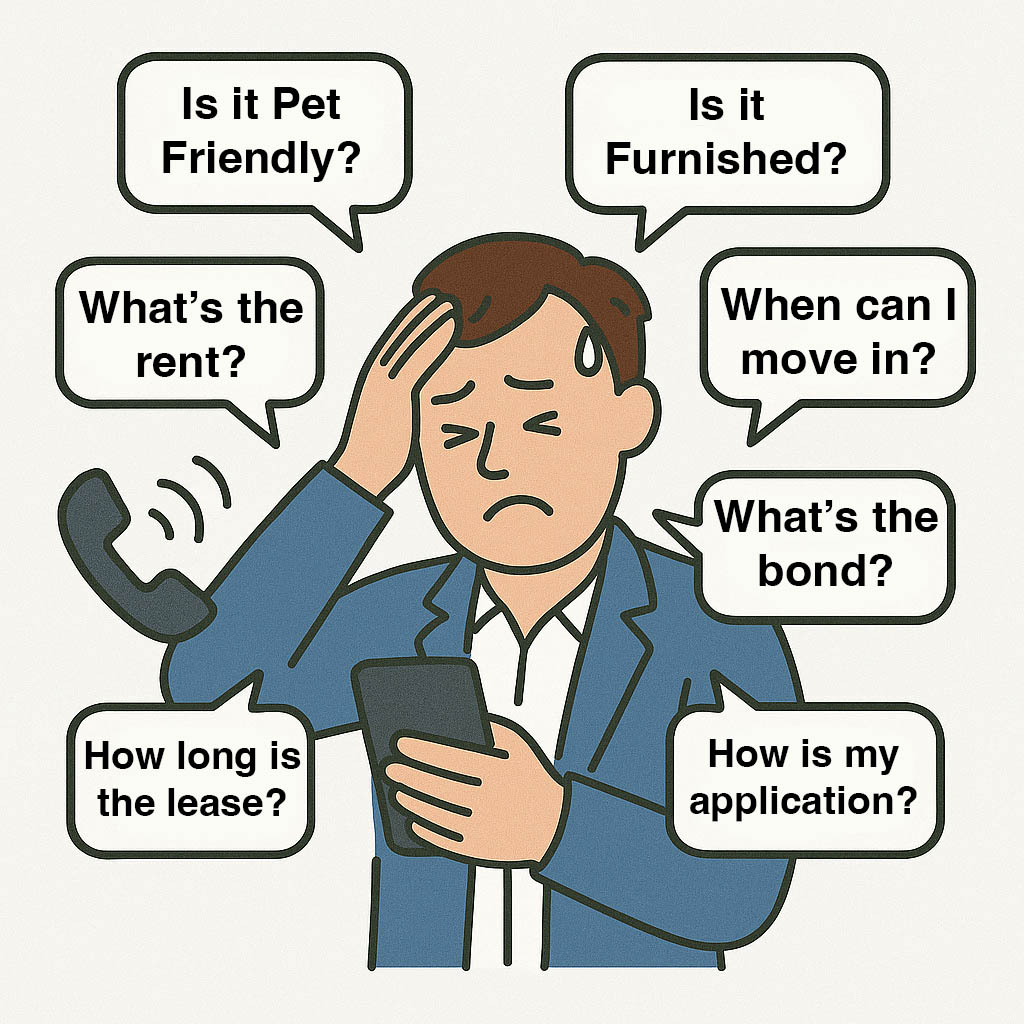
This is the part that gets written off as "just part of the job," and it shouldn't be. Every seam in the tenant's journey comes back to your office as a phone call. How do I apply. Is the cooktop gas or electric. Did you get my application. When's the next inspection. The phone rings every fifteen minutes, all day, and it's the same handful of questions every time.
Not one of those calls exists because the tenant is being difficult. They exist because the software didn't answer the question, so the tenant did the only other thing available to them and rang the office. Bad software doesn't save anyone time, it just moves the work onto your property manager's phone.
And that's the real bill. Your PM is paid to manage a rent roll, and instead spends the day as a switchboard for questions a system should have answered at 9pm last night.
Same journey, two sides. The tenant feels the seams as ads, dead ends and waiting. The property manager feels them as logins, re-keying, chasing, and a phone that never stops. They are not two problems to solve separately.
And this is the fine line. Optimise only the tenant side and you get a slick front end that dumps a mess on the PM to clean up. Optimise only the PM side and you get an efficient back office that feels cold and clunky to the renter. They have to line up, and they only really line up when it's one path instead of five handoffs.
That's the question worth asking before any renewal. Not what the software costs, but how many seams it leaves in the journey, and who is paying to paper over them.
The real question isn't "will this save time?"
It's "what does this replace?"
If a new tool doesn't remove something from the stack, it's not a saving. It's an addition. You're paying twice for overlapping functions and asking your PMs to remember which screen holds which piece of the puzzle.
That's the test I'd put every proptech pitch through right now, including mine. Not "is it clever" but "what comes off the invoice when this goes on?"
Where Crayons Leasing sits
We built Crayons Leasing because the leasing and tenant communication end of the business was where the doubling-up was worst. Enquiry responders that can't answer a real question. Application platforms that don't talk to your comms. Inspection registrations sitting in one portal while your PM fields the same five questions by phone.
Crayons Leasing handles the tenant conversation end to end. Sophie, our AI leasing assistant, answers real enquiries with real property detail, two-way, by SMS and email, in real time. Not a canned autoresponder that says "thanks, we'll be in touch." An actual answer to an actual question at 9pm on a Sunday.
For most agencies, that means at least one or two line items come off the stack.
And the cost
This is the part that usually gets a raised eyebrow, so I'll be blunt about it.
Crayons Leasing is free to your agency. Not a trial, not a discounted first year. We've built a commercial model where a connection partner funds the platform, so the agency doesn't carry the subscription.
Now, the obvious question. If a connection partner is funding it, what happens to the referral income you're already earning on power connections?
It's protected. That's written into the commercial agreement, not a handshake. You keep what you earn now.
And we've gone a step further than protecting it. Because the connection sits inside the tenant journey rather than bolted on the end of it, it gets put in front of the tenant at the point they're actually ready to act on it. Better placement, better conversion. The aim is that your agency earns more from connections than it does today, not less, while the platform itself costs you nothing.
We did that on purpose. In a market where every other vendor is adding to your monthly spend, we'd rather take the cost conversation off the table entirely and let the product argue for itself.
The point
When the sales market is up in the air, your PM department is your insurance policy. The last thing it needs is a fatter software bill and a team stretched across six platforms to answer one tenant question.
Audit the stack. Work out what each subscription actually replaces. And if you want to see what taking a line item off the invoice looks like, have a look at what we've built.